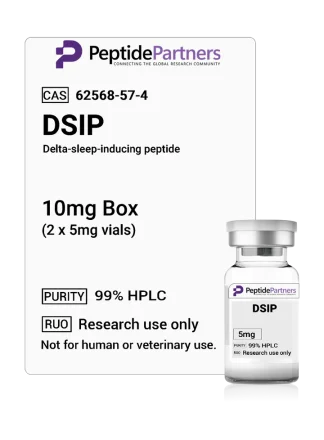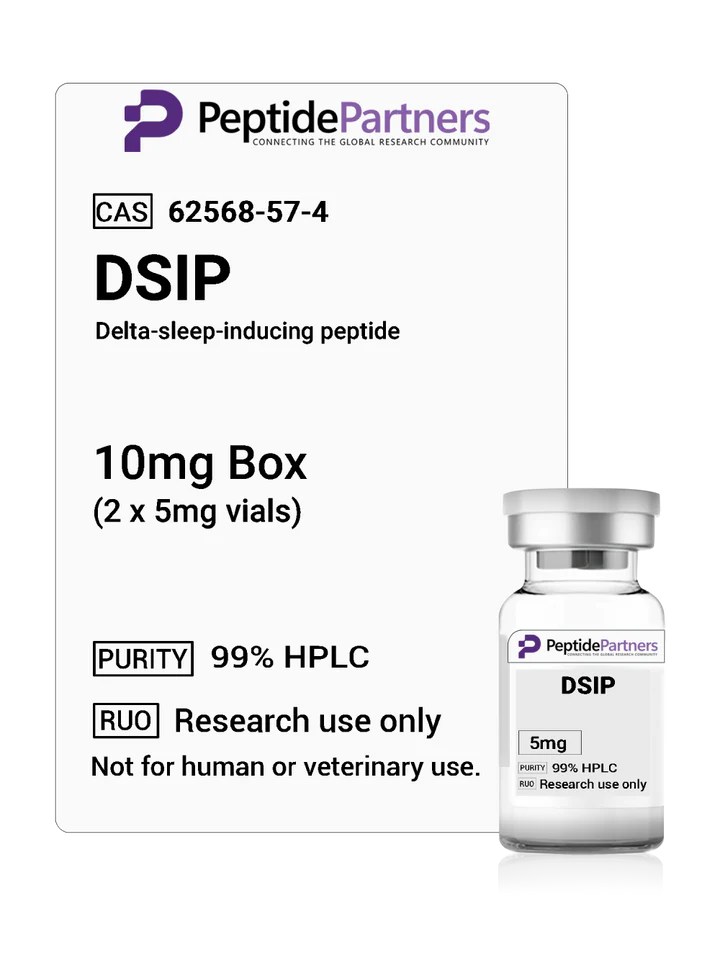
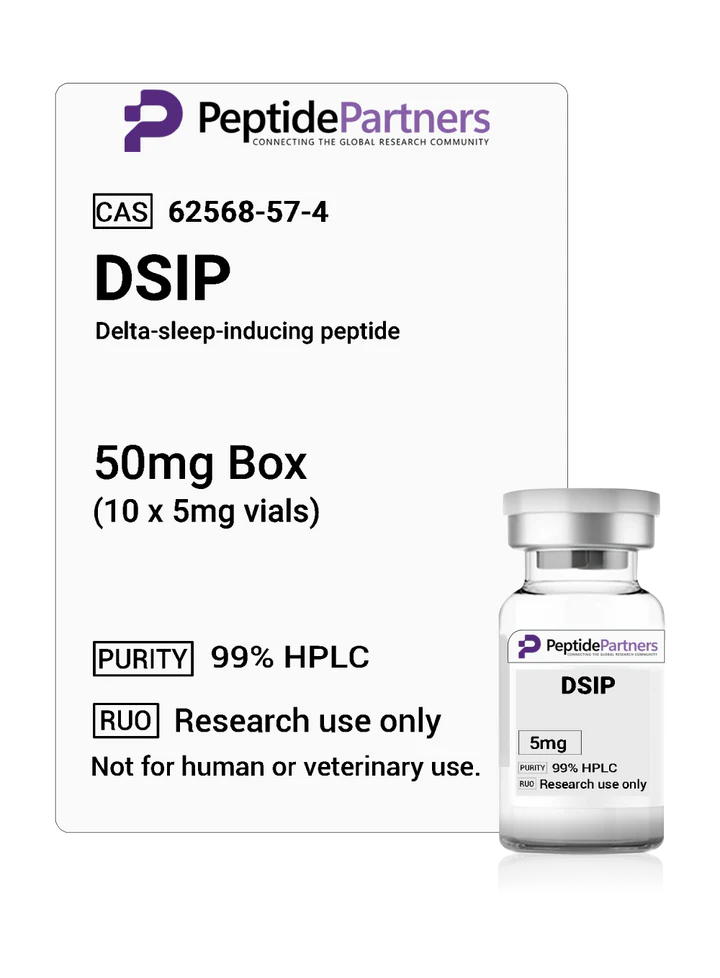
DSIP (5mg vials)

Price range: $75.00 through $305.00

DSIPDelta-sleep-inducing peptide Save over 40%! Swipe right to view full table → Product Format 5mg vials Vial Size 5mg Vial Capacity 3 mL Box Combinations 10mg, 25mg, 50mg Multi-vial Purity 99.81% Endotoxin Screening PASSED Heavy Metals Screening PASSED Purity Screening PASSED Independently Tested YES Research Studies (for research purposes only) Study 1: Induction of pituitary cell type differentiation by delta sleep-inducing peptide Authors: A G Héritier, O Stettler, P M Dubois Source: https://pubmed.ncbi.nlm.nih.gov/8022523/Scientific Findings The effects of delta sleep-inducing peptide (DSIP) on pituitary cell differentiation was studied using an in vitro method and immunocytochemical techniques. Pituitary primordia were explanted from…

SKU: PTP-DSIP-5MG-VIALS
Category:

Description

DSIP

Delta-sleep-inducing peptide

Save over 40%!

Swipe right to view full table →

Product Format 5mg vials
Vial Size 5mg
Vial Capacity 3 mL
Box Combinations 10mg, 25mg, 50mg
Multi-vial Purity 99.81%
Endotoxin Screening PASSED
Heavy Metals Screening PASSED
Purity Screening PASSED
Independently Tested YES

Research Studies

(for research purposes only)

Study 1: Induction of pituitary cell type differentiation by delta sleep-inducing peptide

Authors: A G Héritier, O Stettler, P M Dubois

Source: https://pubmed.ncbi.nlm.nih.gov/8022523/

Scientific Findings

The effects of delta sleep-inducing peptide (DSIP) on pituitary cell differentiation was studied using an in vitro method and immunocytochemical techniques. Pituitary primordia were explanted from 11-day-old rat fetuses and cultured in a synthetic medium enriched with either DSIP at several concentrations, GnRH (10(-9) M) or TRH (10(-9) M). Expression of different pituitary phenotypes was quantified as the percentage of immunoreactive area per section of cultured primordia. Addition of DSIP during the first day of culture induced differentiation of LH and TSH cells only. The effect was dose-dependent. DSIP was less potent than GnRH and as potent as TRH in inducing LH and TSH differentiation. DSIP also induced lactotrope differentiation, but this effect may not be direct. DSIP had no effect on somatotrope and corticotrope differentiation. These results obtained in vitro suggest that DSIP exerts a direct action on the differentiation of several pituitary precursor cells.

Plain English Interpretation

In a laboratory setting, researchers investigated how a substance called delta sleep-inducing peptide (DSIP) affects the development of different cell types in the pituitary gland. They took pituitary glands from rat embryos and grew them in a nutrient-rich liquid, adding DSIP at various concentrations. They found that DSIP specifically triggered the development of cells that produce luteinizing hormone (LH) and thyroid-stimulating hormone (TSH). The more DSIP they added, the greater the effect. While DSIP also seemed to encourage the growth of prolactin-producing cells, this might not be a direct result of DSIP’s action. The study concluded that DSIP directly influences the development of certain types of pituitary cells, suggesting it plays a role in the gland’s formation and function.

Study 2: In-vitro characterization of blood-brain barrier permeability to delta sleep-inducing peptide

Authors: S Raeissi, K L Audus

Source: https://pubmed.ncbi.nlm.nih.gov/2576448/

Scientific Findings

The diffusion of delta sleep-inducing peptide (DSIP) across the blood-brain barrier (BBB) has been investigated with an in-vitro model comprised of primary cultures of brain microvessel endothelial cell (BMEC) monolayers. The BMEC monolayers were mounted in a side-by-side diffusion apparatus and the transendothelial flux of DSIP analysed by HPLC with UV detection at 280 nm. The transendothelial flux of the peptide was linear with time and increasing concentrations of DSIP (non-saturable), but was not altered by reduced temperature. The apparent permeability coefficient for DSIP penetration of BMEC monolayers was in a range similar to water-soluble substances (e.g. fluorescein, fluorescein isothiocyanate dextrans) that penetrate the blood-brain barrier to a limited degree based on molecular weight. DSIP flux across the BMEC monolayers was also found to be bidirectional, insensitive to metabolic inhibitors, and not altered by high concentrations of tryptophan. Little degradation (apparent t1/2 about 10 h) of DSIP to major metabolites, tryptophan (trp) and des-trp DSIP, occurred over the time of the diffusion experiments. The results of these studies support and confirm observations in-vivo indicating that intact DSIP crosses the BBB by simple transmembrane diffusion.

Plain English Interpretation

Scientists created a model of the blood-brain barrier in a lab dish using cells from cow brains to study how a peptide called DSIP crosses it. They found that DSIP can pass through this barrier in both directions, and the amount that gets through increases with higher concentrations of the peptide. The speed at which DSIP crosses is similar to other water-soluble molecules and isn’t affected by temperature or other metabolic processes. The study also showed that DSIP remains largely intact as it crosses the barrier, with very little breaking down into other substances. These findings suggest that DSIP can cross the blood-brain barrier through a simple diffusion process, which helps explain how it can have effects on the brain.

Study 3: Human pheochromocytoma cells studied in culture contain large amounts of DSIP-like material

Authors: Ola Nilsson, Bo Wängberg, Anneli Wigander, Kerstin Lundmark, Annica Dahlström, Håkan Ahlman, Anders Bjartell, Rolf Ekman

Source: https://www.sciencedirect.com/science/article/pii/019697819190063U

Scientific Findings

Delta sleep-inducing peptide (DSIP)-like immunoreactive (LI) material has been detected in nine different human pheochromocytoma tumors by immunocytochemistry. In primary tumors subjected to indirect immunofluorescence a variable number of tumor cells (25–75%) showed positive cytoplasmic labeling after incubation with DSIP antiserum. Tumor cells grown in culture were strongly labeled by the DSIP antiserum with DSIP-LI concentrated to cell bodies. Electron microscopic immunocytochemistry (immunogold labeling) of pheochromocytoma cells demonstrated DSIP-LI over the dense core of secretory granules. The presence of DSIP-LI in several HPLC fractions from conditioned culture media indicates secretion of DSIP-LI from cultured pheochromocytoma cells. The observations suggest that DSIP-LI is synthesized and stored in secretory granules before release. The different HPLC profiles from each of the tumors may reflect differences in processing or turnover of DSIP-LI in pheochromocytoma cells.

Plain English Interpretation

Researchers found a substance similar to delta sleep-inducing peptide (DSIP) in nine different tumors from human adrenal glands. Using special staining techniques, they saw that this DSIP-like material was present in the cytoplasm of the tumor cells. When they grew these tumor cells in a lab dish, the cells were filled with this substance. With a powerful microscope, they could see that the DSIP-like material was stored in tiny sacs inside the cells called secretory granules. They also found that the cells released this substance into the liquid they were growing in. This suggests that the tumor cells make and store this DSIP-like substance before releasing it. The researchers also noticed that the exact form of the substance varied between different tumors, which might mean that it’s processed differently in each case.

Research Use Only. Not for use in diagnostic tests.

This product is solely intended for research purposes as a chemical compound. Its designation permits its use exclusively for in-vitro testing and laboratory experimentation. All information regarding this product provided on our website is purely educational. By law, any form of bodily introduction of this product into humans or animals is strictly prohibited. It should only be handled by professionals who are licensed and qualified. This product is neither a drug, food, nor cosmetic, and must not be misrepresented, misused, or mislabeled as such.

Additional information

QUANTITY (MG)

10 mg, 25 mg, 50 mg

Reviews

There are no reviews yet.

Be the first to review “DSIP (5mg vials)”

Your email address will not be published. Required fields are marked *

Related products