
Description
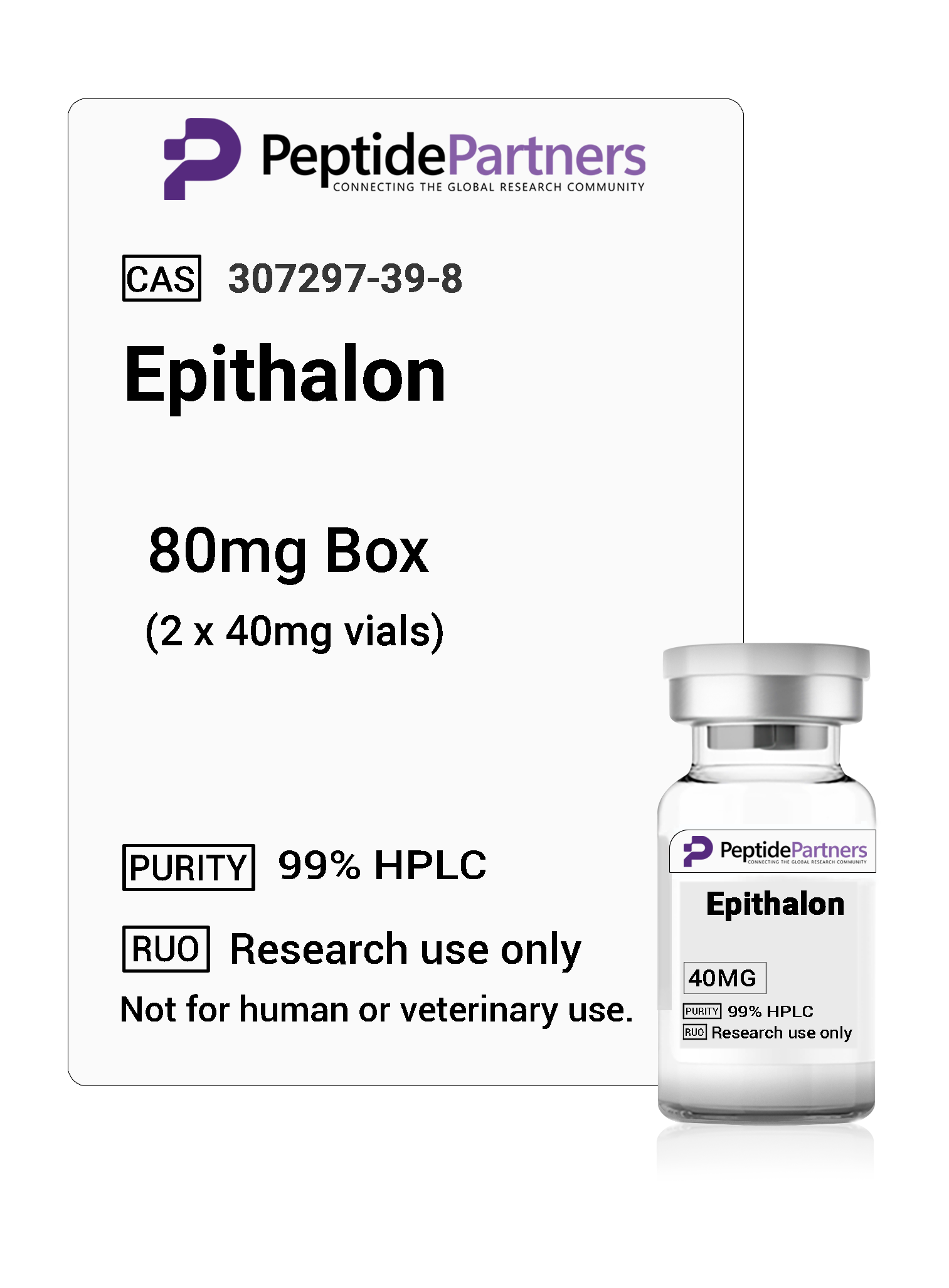
Epithalon (Epitalon, AEDG) is a synthetic tetrapeptide (Ala-Glu-Asp-Gly). Peptide Partners supplies Epithalon in 40mg vials for in-vitro and laboratory research into cellular aging models, gene expression and oxidative-stress pathways.
Epithalon specifications
| Product Format | 40mg vials |
| Vial Size | 40mg |
| Vial Capacity | 3 mL |
| Box Combinations | 80mg, 200mg, 400mg |
| Multi-vial Purity | 99.86% |
| Endotoxin Screening | PASSED |
| Heavy Metals Screening | PASSED |
| Purity Screening | PASSED |
| Independently Tested | YES |
Published research on Epithalon
The summaries below describe peer-reviewed literature for educational and reference purposes only. They do not describe uses of this product, which is sold for laboratory research only.
Epitalon Protects Against Post-Ovulatory Aging-Related Damage of Mouse Oocytes In Vitro
Authors: X. Yue, S. Liu, J. Guo, T. Meng, X. Zhang, H. Li, C. Song, Z. Wang
Source: https://pubmed.ncbi.nlm.nih.gov/35413689/
In a mouse oocyte post-ovulatory aging model, Epitalon was added to the culture medium and oocyte quality was assessed at 6, 12 and 24 hours, including reactive oxygen species, spindle and cortical-granule defects, mitochondrial membrane potential, mtDNA copy number and apoptosis.
AEDG Peptide (Epitalon) Stimulates Gene Expression and Protein Synthesis During Neurogenesis: Possible Epigenetic Mechanism
Authors: V. Khavinson, F. Diomede, E. Mironova, N. Linkova, S. Trofimova, O. Trubiani, S. Caputi, B. Sinjari
Source: https://pubmed.ncbi.nlm.nih.gov/32019204/
In human gingival mesenchymal stem cells, researchers measured mRNA and protein levels of the neurogenic markers Nestin, GAP43, β-Tubulin III and Doublecortin after AEDG exposure, and used molecular modeling to propose binding to histone H1 regions.
Peptide Regulation of Skin Fibroblast Functions During Their Aging In Vitro
Authors: N. Lin'kova, A. Drobintseva, O. Orlova, E. Kuznetsova, V. Polyakova, I. Kvetnoy, V. Khavinson
Source: https://pubmed.ncbi.nlm.nih.gov/27259496/
Short peptides including AEDG were tested in aging skin-fibroblast cultures, with researchers measuring MMP-9 synthesis, Ki-67 and CD98hc expression, and caspase-dependent apoptosis markers across passages.
Storage and handling
Epithalon is supplied for laboratory use. Store unopened vials cold and protected from light, and follow the storage notes on the vial label. Handle only in an appropriate laboratory setting by qualified personnel.
Research use only
This product is sold solely for in-vitro research and laboratory experimentation. It is not a drug, food, supplement or cosmetic, and is not for human or veterinary use. Information on this page is provided for educational purposes only. Purchasers must be qualified research professionals; see our Terms and Conditions.
Browse more Mitochondrial research peptides, review our testing standards, or see all research peptides.

Reviews
There are no reviews yet.