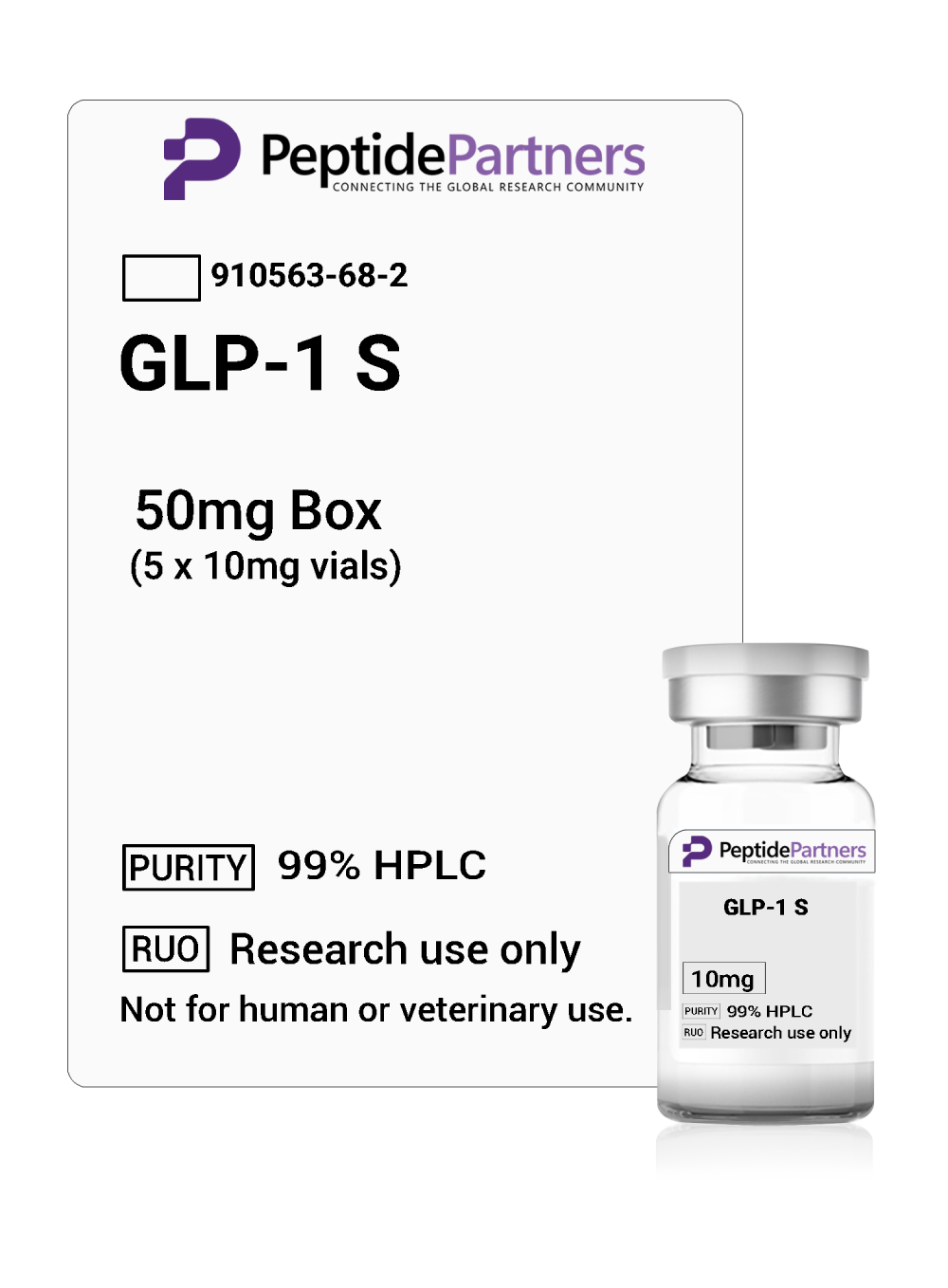
GLP-1 Semaglutide (10mg vials)

Price range: $285.00 through $976.00

GLP-1 Semaglutide Swipe right to view full table → Save over 70%! Product Format 10mg vials Vial Size 10mg Vial Capacity 3 mL Box Combinations 50mg, 100mg, 150mg, 200mg Multi-vial Purity 99.82% Endotoxin Screening PASSED Heavy Metals Screening PASSED Purity Screening PASSED Doubly Validated YES Independently Tested YES Research Studies (for educational purposes only) Study 1: Semaglutide promotes the proliferation and osteogenic differentiation of bone-derived mesenchymal stem cells through activation of the Wnt/LRP5/β-catenin signaling pathway Authors: Yawei Tian, Huiming Liu, Xiaoxue Bao, Yukun Li Source: https://www.frontiersin.org/journals/pharmacology/articles/10.3389/fphar.2025.1539411/fullScientific Findings This in vitro study investigated the effects of semaglutide on bone-derived mesenchymal stem…

SKU: PTP-GLP-1-SEMAGLUTIDE-10MG-VIALS
Category:
Tags:

Description

GLP-1 Semaglutide

Swipe right to view full table →

Save over 70%!

Product Format 10mg vials
Vial Size 10mg
Vial Capacity 3 mL
Box Combinations 50mg, 100mg, 150mg, 200mg
Multi-vial Purity 99.82%
Endotoxin Screening PASSED
Heavy Metals Screening PASSED
Purity Screening PASSED
Doubly Validated YES
Independently Tested YES

Research Studies

(for educational purposes only)

Study 1: Semaglutide promotes the proliferation and osteogenic differentiation of bone-derived mesenchymal stem cells through activation of the Wnt/LRP5/β-catenin signaling pathway

Authors: Yawei Tian, Huiming Liu, Xiaoxue Bao, Yukun Li

Source: https://www.frontiersin.org/journals/pharmacology/articles/10.3389/fphar.2025.1539411/full

Scientific Findings

This in vitro study investigated the effects of semaglutide on bone-derived mesenchymal stem cells (BMSCs). The results demonstrated that semaglutide promotes BMSC proliferation and osteogenic differentiation. This was evidenced by increased alkaline phosphatase (ALP) activity, enhanced mineralization, and upregulation of osteogenic markers such as osteocalcin (OCN) and Runt-related transcription factor 2 (RUNX2). RNA sequencing analysis revealed the activation of the Wnt/LRP5/β-catenin signaling pathway. The study confirmed that semaglutide’s pro-osteogenic effects are mediated through this pathway by using a Wnt inhibitor (DKK1) and activator (LiCl).

Plain English Interpretation

This laboratory study explored how the drug semaglutide affects stem cells taken from bone marrow. The researchers found that semaglutide encourages these stem cells to multiply and transform into bone-forming cells. This was observed through various experiments that showed an increase in the activity of enzymes and proteins essential for bone formation. The study identified a specific communication pathway within the cells, known as the Wnt pathway, which is activated by semaglutide to produce these bone-strengthening effects. This suggests that semaglutide could have potential benefits for bone health by promoting the generation of new bone tissue.

Study 2: The effect of Semaglutide on mitochondrial function and insulin sensitivity in a myotube model of insulin resistance

Authors: Emmalie R. Spry, Kipton B. Travis, Kayla J. Ragland, Alexa J. Klein, John M. Zimmerman, Roger A. Vaughan

Source: https://www.sciencedirect.com/science/article/abs/pii/S0303720725001807

Scientific Findings

This study investigated the effects of semaglutide on C2C12 myotubes in an in vitro model of insulin resistance. The researchers found that while semaglutide did not alter insulin sensitivity, as measured by pAkt:Akt ratio, it did significantly increase the expression of genes associated with mitochondrial biogenesis and function, including PGC-1α, and TFAM. Furthermore, semaglutide treatment led to an increase in mitochondrial content and density, as well as an increase in maximal mitochondrial respiration. These findings suggest that semaglutide may improve metabolic health by enhancing mitochondrial function in skeletal muscle, independent of its effects on insulin signaling.

Plain English Interpretation

In this lab experiment, scientists looked at how the drug semaglutide affects muscle cells that have been made resistant to insulin, similar to what happens in type 2 diabetes. They discovered that while semaglutide didn’t make the cells more responsive to insulin, it did boost the number and activity of mitochondria, which are the ‘powerhouses’ of the cells. This means that semaglutide might help improve metabolism by making muscle cells better at producing energy, even if it doesn’t directly fix the insulin resistance problem.

Study 3: Semaglutide-mediated protection against Aβ correlated with enhancement of autophagy and inhibition of apotosis

Authors: Yan-fang Chang, Di Zhang, Wei-min Hu, Dong-xing Liu, Lin Li

Source: https://www.sciencedirect.com/science/article/abs/pii/S0967586820315332

Scientific Findings

This in vitro study investigated the neuroprotective effects of semaglutide in a SH-SY5Y cell line model of Alzheimer’s disease, induced by amyloid-β 25-35 (Aβ25-35). The results showed that semaglutide treatment restored cell viability that was inhibited by Aβ25-35. Mechanistically, semaglutide was found to enhance autophagy, as indicated by increased expression of autophagy-related proteins such as LC3-II, Atg7, and Beclin-1, and decreased expression of p62. Furthermore, semaglutide inhibited apoptosis by increasing the Bcl-2/Bax ratio. These findings suggest that semaglutide protects against Aβ-induced neurotoxicity by promoting autophagy and suppressing apoptosis.

Plain English Interpretation

In this laboratory study, scientists used a cell model to mimic the effects of Alzheimer’s disease on brain cells. They found that the drug semaglutide could protect these cells from damage. Semaglutide appeared to work in two main ways: first, it boosted the cells’ natural ‘recycling’ process, called autophagy, which helps clear out harmful substances. Second, it prevented the cells from self-destructing, a process known as apoptosis. This research suggests that semaglutide could have a protective effect on brain cells, which might be relevant for neurodegenerative diseases like Alzheimer’s.

Research Use Only. Not for use in diagnostic tests.

This product is solely intended for research purposes as a chemical compound. Its designation permits its use exclusively for in-vitro testing and laboratory experimentation. All information regarding this product provided on our website is purely educational. By law, any form of bodily introduction of this product into humans or animals is strictly prohibited. It should only be handled by professionals who are licensed and qualified. This product is neither a drug, food, nor cosmetic, and must not be misrepresented, misused, or mislabeled as such.

Additional information

QUANTITY (MG)

100 mg, 150 mg, 200 mg, 50 mg

Reviews

There are no reviews yet.

Be the first to review “GLP-1 Semaglutide (10mg vials)”

Your email address will not be published. Required fields are marked *

Related products