

Description
Kisspeptin
Swipe right to view full table →
Save over 35%!
| Product Format | 10mg vials |
| Vial Size | 10mg |
| Vial Capacity | 3 mL |
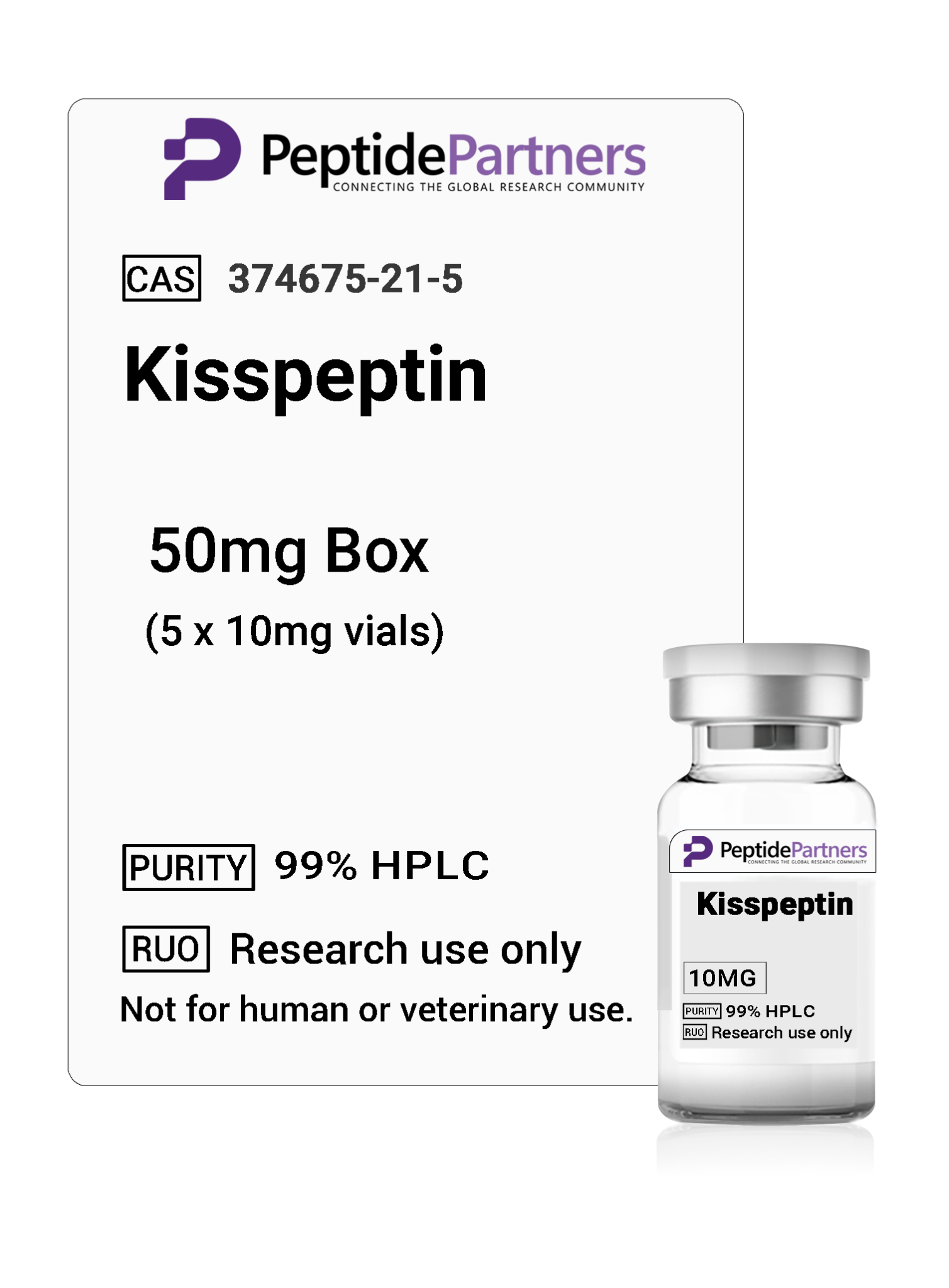
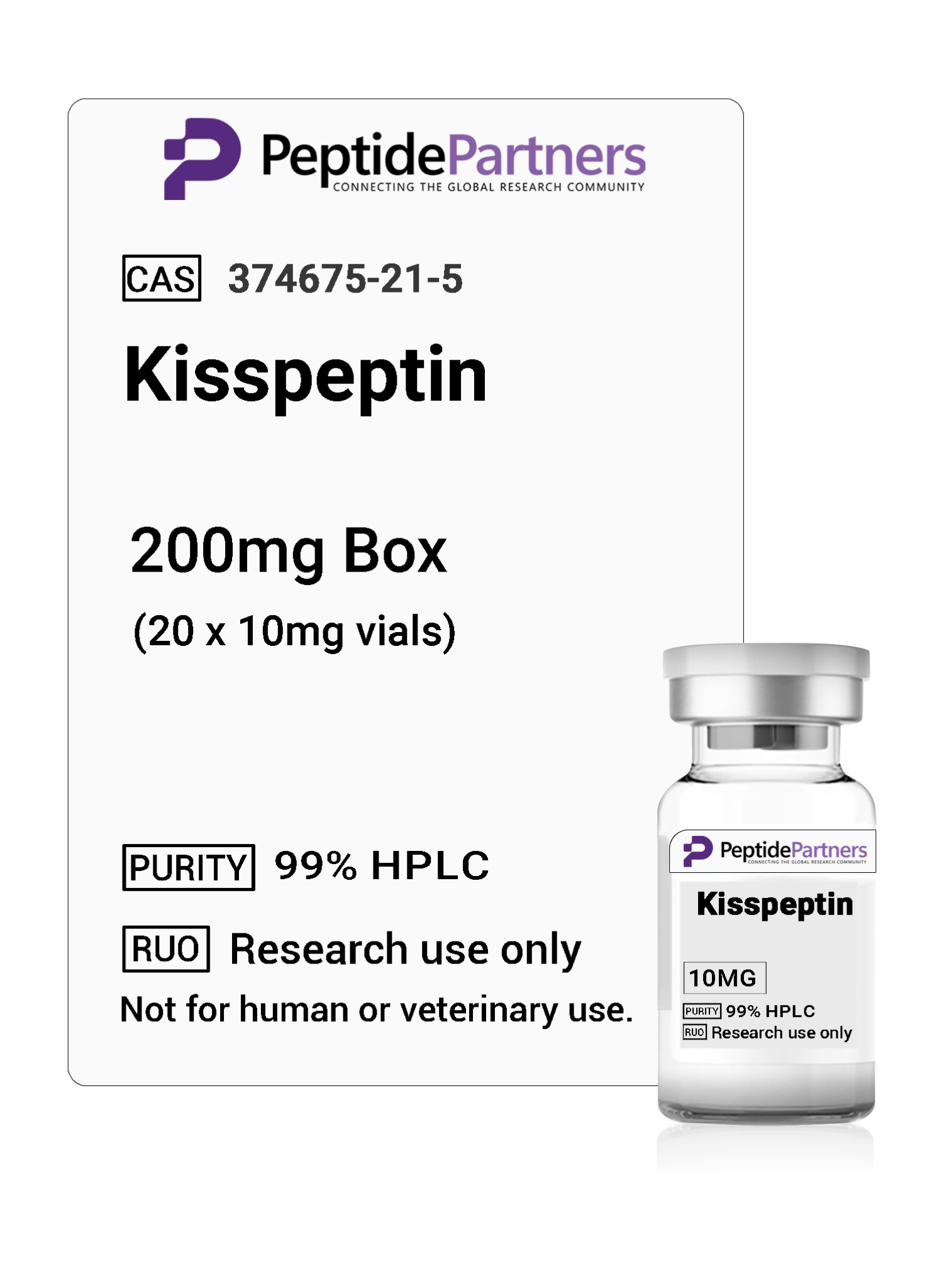
| Box Combinations | 20mg, 50mg, 100mg, 200mg |
| Multi-vial Purity | 99.713% |
| Endotoxin Screening | PASSED (<0.20 EU/mL) |
| Heavy Metals Screening | PASSED |
| Sterility Screening | PASSED |
| Independently Tested | YES |
Notes: Five-vial batch average net content: 11.31 mg.
Overview
(For educational purposes only)
Kisspeptin-10 (KP-10) is the C-terminal 10-amino-acid fragment shared by the kisspeptin family and retains activity at the KISS1 receptor (KISS1R/GPR54). In laboratory research, it is used to investigate neuroendocrine signaling, receptor activation, intracellular calcium mobilization, MAP-kinase pathways, and cellular migration models. This product is supplied strictly for laboratory research use and is not intended for human or veterinary use.
Research Studies
(for educational purposes only)
Study 1: The metastasis suppressor gene KiSS-1 encodes kisspeptins, the natural ligands of the orphan G protein-coupled receptor GPR54
Authors: Kotani M, Detheux M, Vandenbogaerde A, et al.
Source: The Journal of Biological Chemistry (2001) — PubMed
Scientific Findings
The investigators isolated kisspeptin peptides derived from KiSS-1 and identified them as low-nanomolar ligands for human and rat GPR54. Receptor activation induced phosphoinositide hydrolysis, calcium mobilization, MAP-kinase signaling, and other cellular responses.
Plain English Interpretation
A foundational receptor study establishing kisspeptins as the natural signaling molecules for GPR54 and mapping the downstream cellular response.
Study 2: Metastasis suppressor gene KiSS-1 encodes peptide ligand of a G-protein-coupled receptor
Authors: Ohtaki T, Shintani Y, Honda S, et al.
Source: Nature (2001) — PubMed
Scientific Findings
The study identified a 54-amino-acid KiSS-1-derived peptide, named metastin, as an endogenous ligand for hOT7T175/GPR54. Metastin inhibited chemotaxis and invasion in receptor-expressing cells in vitro and reduced pulmonary metastasis in a receptor-expressing mouse melanoma model.
Plain English Interpretation
A second foundational study linking the KiSS-1 peptide system to its receptor and to anti-migratory effects in cell and animal research models.
Study 3: The GPR54 gene as a regulator of puberty
Authors: Seminara SB, Messager S, Chatzidaki EE, et al.
Source: The New England Journal of Medicine (2003) — PubMed
Scientific Findings
Using human genetic studies, receptor-function assays, and a Gpr54-deficient mouse model, the investigators showed that loss-of-function GPR54 mutations disrupt gonadotropin-releasing hormone physiology and normal pubertal development.
Plain English Interpretation
This study established the kisspeptin receptor as an essential regulator of reproductive signaling and puberty in humans and mice.
Research Use Only. Not for use in diagnostic tests.
This product is solely intended for research purposes as a chemical compound. Its designation permits its use exclusively for in-vitro testing and laboratory experimentation. All information regarding this product provided on our website is purely educational. By law, any form of bodily introduction of this product into humans or animals is strictly prohibited. It should only be handled by professionals who are licensed and qualified. This product is neither a drug, food, nor cosmetic, and must not be misrepresented, misused, or mislabeled as such.


Reviews
There are no reviews yet.