

Description
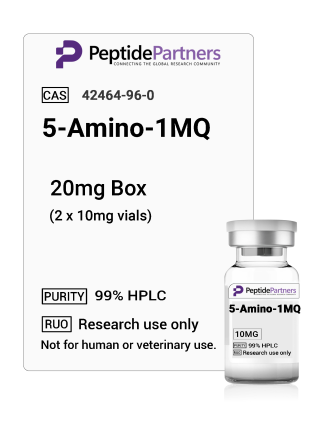
5-Amino-1MQ (5-amino-1-methylquinolinium) is a small-molecule, membrane-permeable inhibitor of the enzyme nicotinamide N-methyltransferase (NNMT). Peptide Partners supplies 5-Amino-1MQ in 10mg vials for laboratory research into NNMT, NAD+ salvage and methyl-donor metabolism.
5-Amino-1MQ specifications
| Product Format | 10mg vials |
| Vial Size | 10mg |
| Vial Capacity | 3 mL |
| Box Combinations | 20mg, 50mg, 100mg |
| Multi-vial Purity | 99.66% |
| Endotoxin Screening | PASSED |
| Heavy Metals Screening | PASSED |
| Purity Screening | PASSED |
| Doubly Validated | YES |
| Independently Tested | YES |
Published research on 5-Amino-1MQ
The summaries below describe peer-reviewed literature for educational and reference purposes only. They do not describe uses of this product, which is sold for laboratory research only.
Selective and Membrane-Permeable Small Molecule Inhibitors of Nicotinamide N-Methyltransferase Reverse High Fat Diet-Induced Obesity in Mice
Authors: Harshini Neelakantan, Virginia Vance, Michael D. Wetzel, Hua-Yu Leo Wang, Stanton F. McHardy, Celeste C. Finnerty, Jonathan D. Hommel, Stanley J. Watowich
Published: Biochemical Pharmacology, 2018 Jan;147:141-152
Source: https://pubmed.ncbi.nlm.nih.gov/29155147/
Researchers evaluated methylquinolinium-based NNMT inhibitors, including 5-amino-1-methylquinolinium, for selectivity and membrane permeability. In cultured adipocytes, NNMT inhibition lowered 1-methylnicotinamide, raised NAD+ and SAM and reduced lipogenesis, and the compound was further studied in diet-induced obese mice.
Reduced Calorie Diet Combined With NNMT Inhibition Establishes a Distinct Microbiome in DIO Mice
Authors: Andrea Dimet-Wiley, Qinglong Wu, Jerrin T. Wiley, Aditya Eswar, Harshini Neelakantan, Tor Savidge, Stanley J. Watowich
Published: Scientific Reports, 2022;12:358
Source: https://pubmed.ncbi.nlm.nih.gov/35013352/
In diet-induced obese mice switched to a low-fat diet, researchers used 16S rRNA sequencing and adipose-tissue metabolite correlations to compare the cecal microbiome of animals receiving an NNMT inhibitor with diet switch alone.
Roles of Nicotinamide N-Methyltransferase in Obesity and Type 2 Diabetes
Authors: Jie-Ru Liu, Zhao-Hui Deng, Xiao-Juan Zhu, Yu-Rong Zeng, Xiang-Xiang Guan, Jiang-Hua Li
Published: BioMed Research International, 2021
Source: https://pmc.ncbi.nlm.nih.gov/articles/PMC8337113/
This review summarizes the biochemistry of NNMT, which methylates nicotinamide using S-adenosylmethionine, and discusses cellular and animal studies of NNMT knockdown and inhibition, including 5-Amino-1MQ, in metabolic research.
Storage and handling
5-Amino-1MQ is supplied for laboratory use. Store unopened vials cold and protected from light, and follow the storage notes on the vial label. Handle only in an appropriate laboratory setting by qualified personnel.
Research use only
This product is sold solely for in-vitro research and laboratory experimentation. It is not a drug, food, supplement or cosmetic, and is not for human or veterinary use. Information on this page is provided for educational purposes only. Purchasers must be qualified research professionals; see our Terms and Conditions.
Browse more Metabolics research peptides, review our testing standards, or see all research peptides.

Reviews
There are no reviews yet.