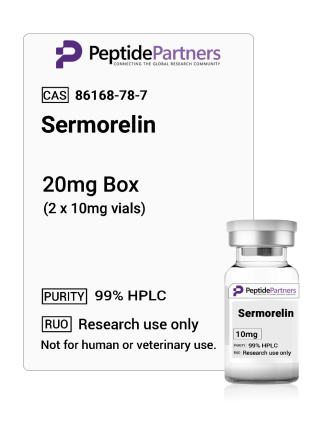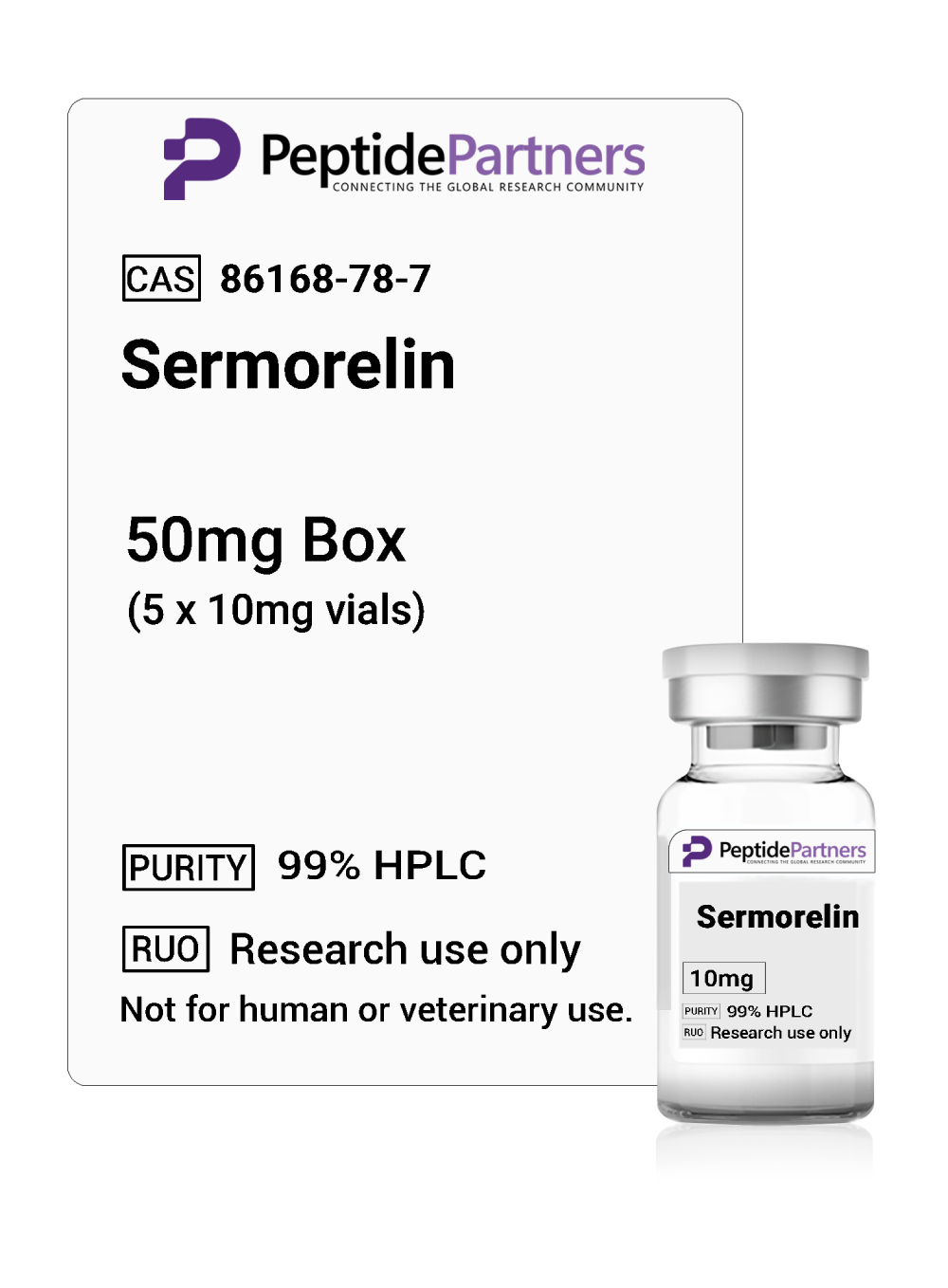
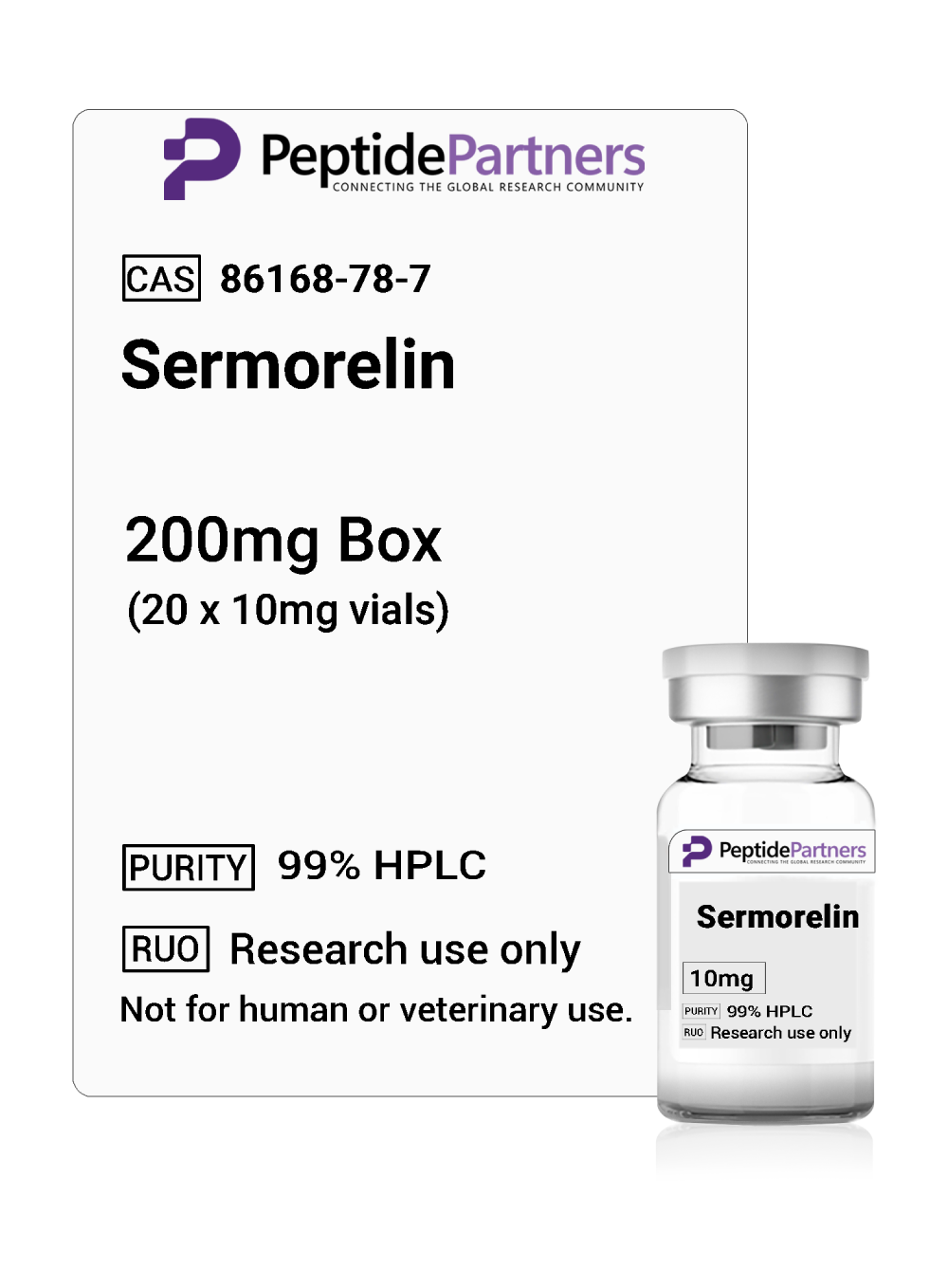
Sermorelin (10mg vials)

Price range: $98.00 through $797.00

Sermorelin Swipe right to view full table → Save over 70%! Product Format 10mg vials Vial Size 10mg Vial Capacity 3 mL Box Combinations 20mg, 50mg, 100mg, 200mg Multi-vial Purity 99.94% Endotoxin Screening PASSED Heavy Metals Screening PASSED Purity Screening PASSED Independently Tested YES Research Studies (for research purposes only) Study 1: A potentially effective drug for patients with recurrent glioma: sermorelin Authors: Chang Y, Huang R, Zhai Y, Huang L, Feng Y, Wang D, Chai R, Zhang W, Hu H. Source: https://pmc.ncbi.nlm.nih.gov/articles/PMC8033379/Scientific Findings The study investigated the effect of sermorelin on glioma cell lines U87 and LN229. The results…

SKU: PTP-SERMORELIN-10MG-VIALS
Category:

Description

Sermorelin

Swipe right to view full table →

Save over 70%!

Product Format 10mg vials
Vial Size 10mg
Vial Capacity 3 mL
Box Combinations 20mg, 50mg, 100mg, 200mg
Multi-vial Purity 99.94%
Endotoxin Screening PASSED
Heavy Metals Screening PASSED
Purity Screening PASSED
Independently Tested YES

Research Studies

(for research purposes only)

Study 1: A potentially effective drug for patients with recurrent glioma: sermorelin

Authors: Chang Y, Huang R, Zhai Y, Huang L, Feng Y, Wang D, Chai R, Zhang W, Hu H.

Source: https://pmc.ncbi.nlm.nih.gov/articles/PMC8033379/

Scientific Findings

The study investigated the effect of sermorelin on glioma cell lines U87 and LN229. The results showed that sermorelin inhibited the proliferation of these cells in a dose-dependent manner. The study suggests that sermorelin may inhibit tumor cell proliferation by blocking the cell cycle. Gene ontology (GO) and Kyoto encyclopedia of genes and genomes (KEGG) analyses found that the Drug Resistance Score (DRS) of sermorelin was negatively correlated with cell proliferation and immune function.

Plain English Interpretation

This research explored whether the peptide Sermorelin could be a potential treatment for a type of brain tumor called glioma. The scientists tested Sermorelin on cancer cells in a lab dish and found that it could stop the cancer cells from growing. The study suggests that Sermorelin might work by interfering with the cancer cells’ ability to divide and multiply. It also seems to boost the immune system’s ability to fight the cancer. This is an early-stage study, but it suggests that Sermorelin could be a promising new drug for patients with recurrent glioma.

Study 2: Advances in the detection of growth hormone releasing hormone synthetic analogs

Authors: Memdouh S, Gavrilović I, Ng K, Cowan D, Abbate V.

Source: https://analyticalsciencejournals.onlinelibrary.wiley.com/doi/10.1002/dta.3183

Scientific Findings

This study investigates the in vitro metabolism of four growth hormone-releasing hormone (GHRH) synthetic analogs, including sermorelin, in fortified urine for anti-doping purposes. The researchers identified nineteen major in vitro metabolites of these GHRH analogs. For sermorelin, several degradation products were identified, which will aid in the development of more effective detection methods for its misuse in sports.

Plain English Interpretation

Scientists in this study were looking for a way to detect if athletes are illegally using substances like Sermorelin to enhance their performance. They developed a method to find these substances in urine. In the lab, they mixed Sermorelin with urine and observed how it breaks down. They identified several smaller pieces, or ‘metabolites’. Knowing what these metabolites look like is crucial for creating a reliable drug test, because the test can then look for these specific markers.

Study 3: Qualitative identification of growth hormone-releasing hormones in human plasma by means of immunoaffinity purification and LC-HRMS/MS

Authors: Knoop A, Thomas A, Fichant E, Delahaut P, Schänzer W, Thevis M.

Source: https://pmc.ncbi.nlm.nih.gov/articles/PMC4830873/

Scientific Findings

This study aimed to develop a method for detecting various growth hormone-releasing hormones (GHRHs), including Sermorelin, in human plasma for anti-doping purposes. In an in-vitro experiment, Sermorelin was incubated in human plasma. The researchers observed that Sermorelin was completely degraded after 4 hours. They identified a metabolite, GRF(3-29), which results from the cleavage of the N-terminal Tyr-Ala-residue by the enzyme dipeptidyl peptidase-IV (DPP-IV). This finding is important for developing effective anti-doping tests, as it’s often the metabolites of a substance, rather than the substance itself, that are detected in biological samples.

Plain English Interpretation

Scientists in this study were looking for a way to detect if athletes are illegally using substances like Sermorelin to enhance their performance. They developed a method to find these substances in blood. In the lab, they mixed Sermorelin with human blood plasma and observed how it breaks down. They found that Sermorelin is broken down into a smaller piece, a ‘metabolite’. Knowing what this metabolite looks like is crucial for creating a reliable drug test, because the test can then look for this specific marker.

Research Use Only. Not for use in diagnostic tests.

This product is solely intended for research purposes as a chemical compound. Its designation permits its use exclusively for in-vitro testing and laboratory experimentation. All information regarding this product provided on our website is purely educational. By law, any form of bodily introduction of this product into humans or animals is strictly prohibited. It should only be handled by professionals who are licensed and qualified. This product is neither a drug, food, nor cosmetic, and must not be misrepresented, misused, or mislabeled as such.

Additional information

QUANTITY (MG)

100 mg, 20 mg, 200 mg, 50 mg

Reviews

There are no reviews yet.

Be the first to review “Sermorelin (10mg vials)”

Your email address will not be published. Required fields are marked *

Related products